
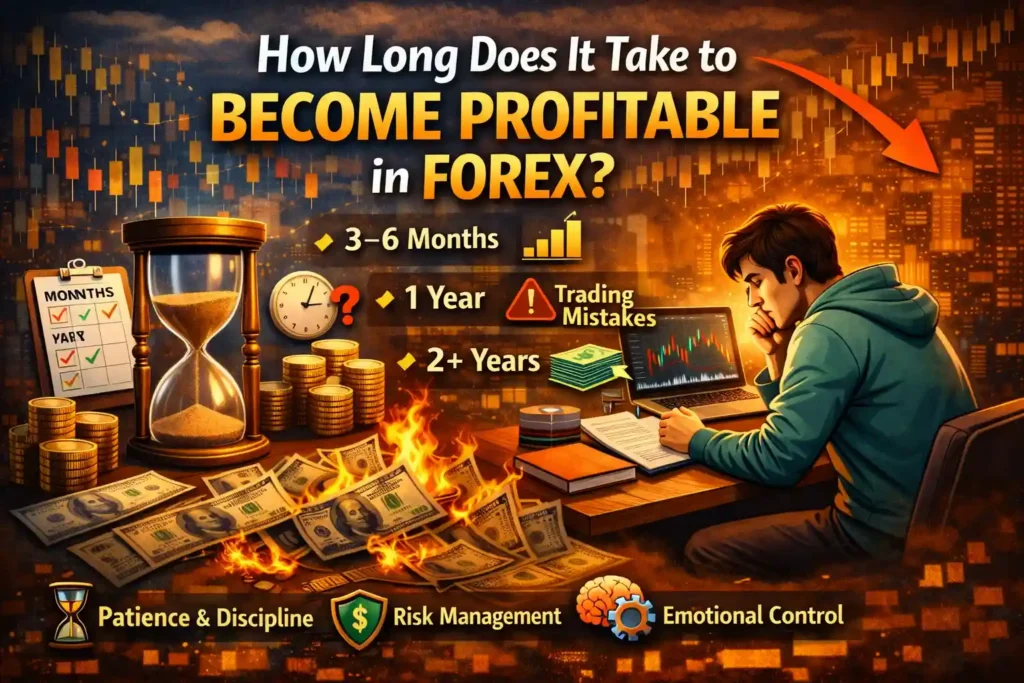
How Long Does It Take to Become Profitable in Forex?
This guide gives a realistic timeline, explains what slows traders down, and shows what to focus on if you want to improve faster.
Key takeaways
- Most beginners are not consistently profitable in the first few months.
- Risk management and discipline matter more than strategy complexity.
- Progress is usually uneven: learning comes in phases.
- Journaling and review speed up improvement.
- Consistency across many trades is the real goal.
What “profitable” actually means in forex
Profitability in forex isn’t one good week or one winning streak. A more useful definition is: positive performance over a large sample of trades while controlling risk.
For beginners, the first “win” is often stopping large losses. Once losses are controlled, consistency becomes possible.
If you’re new to the market, start here first: what forex trading is and how it works.
A realistic timeline to become profitable in forex
Every trader is different, but here’s a realistic timeline many beginners experience when learning in a structured way:
0–3 months: learning the basics
- Understanding how forex works (pairs, spreads, leverage)
- Learning to place orders and use stop losses
- Making common beginner mistakes (normal)
3–9 months: building consistency
- Focusing on one simple strategy
- Learning position sizing and risk management
- Reducing emotional decisions and overtrading
9–18+ months: improving execution and results
- Refining trade selection and management
- Building confidence through repetition
- Tracking performance and fixing repeat mistakes
Some people improve faster, some slower. The key variable is how consistently you follow a structured process.
Why most people take longer than they expect
Beginners often underestimate how much trading is about behavior and risk control.
Common reasons traders take longer than expected include:
- Over-leverage: big losses erase progress and confidence.
- Strategy hopping: no strategy gets tested long enough.
- Overtrading: too many low-quality trades creates noise.
- No journaling: mistakes repeat because they aren’t tracked.
- Unrealistic expectations: pressure leads to forcing trades.
This is also why many people ask why most forex traders lose money.
What to focus on to become profitable faster
You can’t control the market, but you can control your learning process. These areas make the biggest difference:
- Risk management: keep risk per trade small (often 0.5%–1%).
- One strategy: choose one setup and gather data across many trades.
- Process goals: focus on executing rules, not daily profit targets.
- Journaling: record entries, exits, and emotions.
- Weekly review: fix one repeated mistake at a time.
If you need a practical beginner starting plan, use: how to start trading forex as a beginner.
How to tell if you’re improving (even if you’re not profitable yet)
Many traders quit too early because they only measure profit. Improvement often shows up first in these areas:
- Your average loss gets smaller
- You follow rules more consistently
- You take fewer impulsive trades
- You can explain why you entered every trade
- Your results become less “random”
Profitability is usually a delayed result of better decision-making and risk control.
FAQs about becoming profitable in forex
Can you become profitable in forex in 3 months?
It’s possible, but uncommon. Most beginners need more time to build consistency, risk control, and emotional discipline. A better early goal is reducing mistakes and controlling losses.
Why do some traders become profitable faster than others?
Traders usually improve faster when they follow a structured plan, focus on one strategy, keep risk small, and review trades consistently.
Do you need a lot of money to become profitable?
No. Profitability is about process and risk management. However, very small accounts can make risk control harder if position sizing is limited.
What’s the biggest reason beginners don’t become profitable?
The biggest reason is poor risk management—risking too much, using too much leverage, and making emotional decisions after losses.
Is profitability mostly strategy or psychology?
Both matter, but psychology and risk management typically have a bigger impact than strategy alone, especially for beginners.