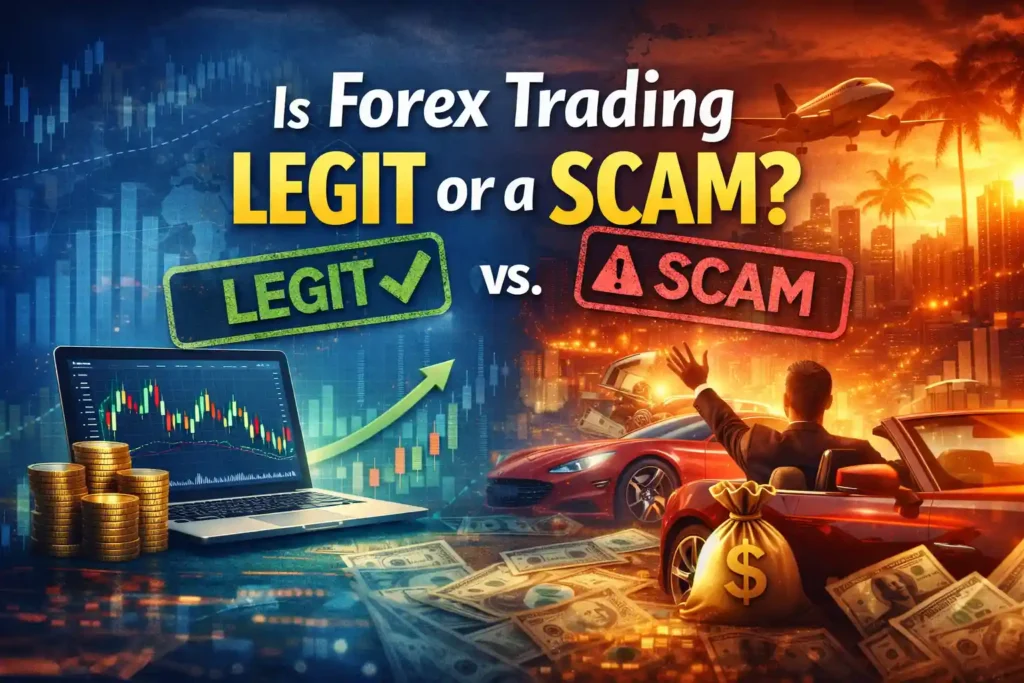
Is Forex Trading Legit or a Scam?
This guide explains the difference between legitimate forex trading and common scams, so beginners know what to avoid.
Key takeaways
- The forex market is real and globally regulated.
- Most “scams” come from people selling false promises, not trading itself.
- Legitimate trading involves risk, discipline, and realistic expectations.
- Guaranteed profits are a major red flag.
- Education quality matters more than signals or shortcuts.
If you’re completely new to the market, it helps to first understand what forex trading is and how it works before judging why traders struggle.
Is forex trading legitimate?
Yes. Forex trading is a legitimate market where currencies are exchanged daily by banks, institutions, corporations, and individual traders. It is the largest financial market in the world by trading volume.
Central banks use the forex market to manage currency stability, and businesses use it to handle international payments. Retail traders participate through brokers that provide access to the market.
Why do people think forex trading is a scam?
Forex trading gets a bad reputation because many people are introduced to it through misleading marketing rather than proper education.
- Promises of guaranteed or “easy” profits
- Fake lifestyle marketing (cars, screenshots, luxury claims)
- Signal groups with no transparency or risk control
- Unqualified educators selling shortcuts
When beginners lose money after believing these claims, they often blame forex itself rather than the source of misinformation.
What real forex trading actually looks like
Legitimate forex trading is slow, disciplined, and often boring. Most professional or consistent traders focus more on risk management than on profits.
In reality:
- Losses are normal and expected
- Returns are inconsistent month to month
- Risk per trade is usually small (often 0.5%–1%)
- Results are measured over dozens or hundreds of trades
This reality is very different from what most scams advertise.
Common forex trading scams to avoid
- Guaranteed profit claims: No trader can guarantee returns.
- Signal-only services: Signals without education create dependency.
- Pressure tactics: “Join now or miss out” is a red flag.
- Fake performance screenshots: Easily manipulated and unverifiable.
- No risk disclosure: Legitimate education always discusses risk.
If the focus is on lifestyle instead of process, caution is warranted.
How to tell if a forex education source is legitimate
- They talk openly about losses and risk.
- No promises of fast or guaranteed profits.
- Clear explanations instead of hype.
- Focus on skills, not signals.
- Encourage practice and patience.
Legitimate educators aim to build understanding, not dependency.
FAQs about forex trading legitimacy
Is forex trading a scam or illegal?
No. Forex trading itself is legal and legitimate in many countries. Scams come from individuals or companies misrepresenting what forex trading involves.
Why do so many forex traders lose money?
Most traders lose money due to poor risk management, unrealistic expectations, emotional trading, and lack of structured education.
Are forex brokers legit?
Some brokers are legitimate and regulated, while others are not. Traders should research regulation, transparency, and reputation before opening an account.
Can you trust forex educators online?
Some educators are legitimate, but many rely on marketing hype. Trust sources that emphasize risk, learning, and long-term development.
Is it realistic to make money trading forex?
Yes, but it is difficult. Consistent profitability usually requires significant time, discipline, and realistic expectations.