
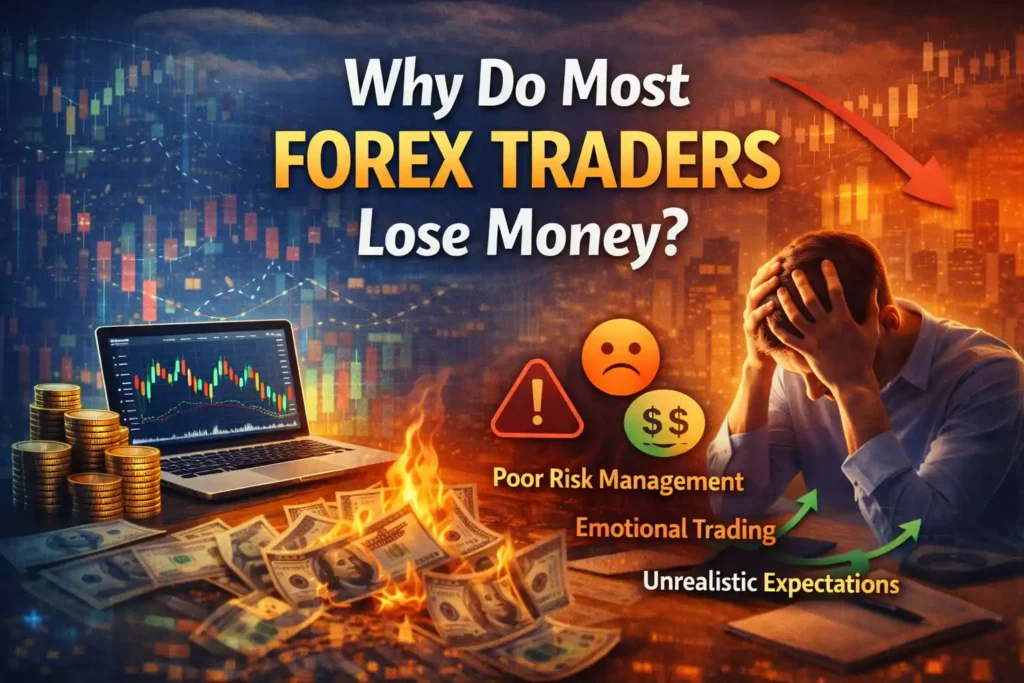
Why Do Most Forex Traders Lose Money?
This guide explains the real reasons traders lose money and what beginners can do differently to improve their odds.
Key takeaways
- Most losses come from behavior, not strategy.
- Risking too much per trade is the fastest way to fail.
- Emotional decisions compound losses.
- Unrealistic expectations lead to forced trades.
- Consistency matters more than being “right.”
The biggest misconception about losing traders
A common belief is that traders lose money because they don’t have the “right” strategy. In reality, many losing traders use strategies that can work—but they execute them inconsistently.
Losses usually come from how trades are managed, not from the setup itself.
Poor risk management
Risk management is the number one reason most forex traders lose money.
- Risking too much per trade
- Moving stop losses emotionally
- Increasing position size after losses
- Using high leverage without understanding risk
Simple example: If you risk 5–10% per trade, just a few losses can significantly damage your account. Risking 0.5%–1% keeps losses manageable and emotions under control.
Emotional trading and lack of discipline
Forex trading triggers strong emotions—fear, greed, frustration, and overconfidence. Without rules, these emotions take control.
Common emotional mistakes include:
- Revenge trading after a loss
- Closing winners too early out of fear
- Holding losers too long hoping they recover
- Overtrading out of boredom
Emotions don’t disappear with experience, but discipline and structure help keep them from controlling decisions.
Unrealistic expectations
Many traders enter forex expecting fast profits or a quick replacement for a job. These expectations create pressure to force trades and ignore risk.
In reality:
- Losses are normal
- Winning streaks don’t last forever
- Consistency matters more than big wins
- Progress is usually slow and uneven
When expectations don’t match reality, frustration leads to mistakes.
Lack of a clear trading plan
Many traders enter trades without clearly defined rules. Without a plan, results become random.
A basic trading plan should answer:
- When do I enter a trade?
- Where is my stop loss?
- How much am I risking?
- When do I exit?
- What conditions tell me not to trade?
Without these answers, decisions are made emotionally in the moment.
A simple framework to avoid common mistakes
- Risk no more than 1% per trade.
- Trade one simple, repeatable setup.
- Follow the same rules for at least 20–30 trades.
- Journal every trade.
- Review mistakes weekly.
This framework won’t guarantee profits, but it dramatically reduces avoidable losses.
FAQs about why forex traders lose money
Do most forex traders really lose money?
Yes. Many retail traders lose money, especially early on. The main reasons are poor risk management, emotional trading, and unrealistic expectations.
Is the forex market rigged against retail traders?
No. The forex market itself isn’t rigged, but it rewards discipline and punishes poor risk control. Traders who ignore this often lose money.
Can traders avoid losing money in forex?
Losses can’t be eliminated completely, but traders can reduce them by controlling risk, following rules, and focusing on consistency.
Is strategy or psychology more important in forex?
Both matter, but psychology and risk management usually have a bigger impact on long-term results than strategy alone.
How long does it take to stop losing money in forex?
Timelines vary, but many traders need months of structured practice and strict risk control before their results stabilise.